
Tide and Time: The Science Behind the Ocean’s Rhythm and How It Shapes Your Beach Vacation

The beach is more than a backdrop for sunbathing and seashell hunts—it’s a living, breathing environment driven by forces that have fascinated humans for centuries. For vacationers, understanding the tides, the sunrise and sunset cycle, and how these phenomena shape the coastal experience can enhance your trip in unexpected ways. The daily rhythm of the sea is rooted in astronomy, physics, and geography. These elements dictate everything from when it’s best to walk the shoreline to when the fishing is best or the surf is highest.
While many beachgoers simply plan their days around the weather forecast, those in the know pay just as much attention to the tide charts and solar cycle. Let’s dig into the science behind tides and sunlight and explore how they influence everything from beach safety to photography and fun.
The Science of Tides: The Moon’s Gravitational Pull in Action
Tides are the result of gravitational forces exerted primarily by the moon, with a lesser but still notable contribution from the sun. Twice a day, oceans rise and fall in a pattern known as semi-diurnal tides. This means that most coastal areas experience two high tides and two low tides in roughly 24 hours. The moon’s gravitational pull draws water toward it, causing a bulge, or high tide, on the side of Earth facing the moon. A second high tide occurs on the opposite side of the Earth due to inertia—the tendency of the water to keep moving as the Earth rotates beneath it.
The Earth’s rotation and the moon’s orbit mean that the timing of high and low tides shifts slightly each day, typically by about 50 minutes. That’s why the tide chart isn’t the same from one day to the next. When the sun, Earth, and moon align during a full moon or new moon, we experience “spring tides,” which are more extreme high and low tides. Conversely, during the first and third quarters of the moon, we get “neap tides,” when the tidal range is smaller.
Understanding these rhythms is more than just a scientific curiosity—it’s a practical way to get the most out of your time at the beach. Whether you’re planning a long shoreline walk, a paddleboarding excursion, or a family day at the tide pools, knowing the tide times can make the difference between a magical experience and a frustrating one.
How Tides Affect Your Beach Vacation Experience
Tides influence far more than just how far the water comes up on the sand. Low tide exposes more of the beach and creates ideal conditions for beachcombing, sandcastle building, and exploring tidal pools. On the other hand, high tide often brings better conditions for swimming, kayaking, and other water sports, especially in areas where shallow water and sandbars are exposed during low tide.
In many areas along the Gulf Coast, tides can also impact beach access. Certain boardwalks or shoreline paths may become submerged at high tide, while low tide may reveal sandbars and walkable flats that offer quiet escapes from the more crowded areas. Understanding local tide patterns can help you choose the best time for photography, shelling, or even fishing.
Fishing, in particular, is strongly tied to the tide cycle. Many seasoned anglers know that fish tend to feed more aggressively during rising or falling tides. This is when baitfish are stirred up by the water movement, attracting larger fish. Planning your fishing charter or beachside casting during these windows can increase your odds of success.
Sunrise and Sunset: The Solar Cycle’s Role in Coastal Beauty
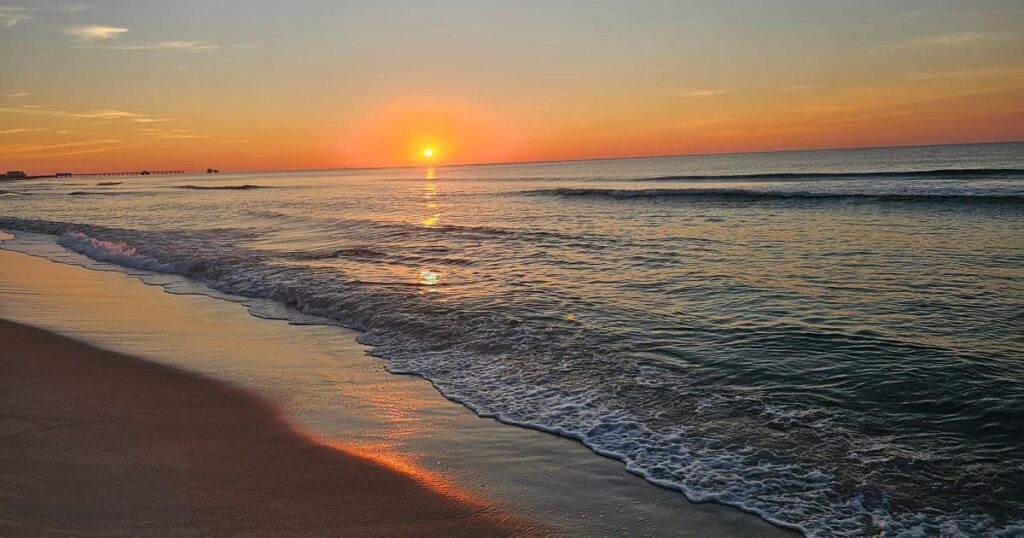
Beyond the tides, the sun’s position in the sky dictates much of what makes the beach experience memorable. The daily rhythm of sunrise and sunset shapes not only your internal clock but the way you interact with the beach itself. The warm golden glow of morning and evening light paints the coast in tones that inspire everything from early-morning yoga sessions to proposal-worthy evening strolls.
Sunrise and sunset times vary throughout the year due to the Earth’s tilt and orbit. In the summer, days are longer because the Northern Hemisphere is tilted toward the sun. This is when sunrise can happen as early as 5:45 a.m. and sunset as late as 8:00 p.m. On the Gulf Coast, the flat horizon provides a perfect stage for the sun’s grand performance, often reflecting off the water in brilliant oranges, pinks, and purples.
These times of day are also when wildlife is most active. Birds feed in the early morning, and dolphins are often seen closer to shore during sunrise and sunset. The cooler temperatures and softer light also make it more comfortable for both humans and animals to be active.
Vacationers who rise early are often rewarded with peaceful beaches, ideal lighting for photos, and the chance to enjoy the calm before the crowds arrive. Meanwhile, sunset lovers know that winding down the day with a walk along the shore as the sky turns fire-red is an unbeatable way to close out a beach day.
The Interplay Between Tides and Sunlight
Though tides are primarily lunar-driven and the solar cycle governs sunrise and sunset, the two are far from unrelated. The sun also contributes to the gravitational forces that cause tides, and it’s the sun’s position that helps determine the visual appearance of tides from the beach.
For instance, during a full moon—when the sun and moon are on opposite sides of Earth—you’ll get particularly high spring tides, which can dramatically reshape the shoreline. The timing of tides can also align with sunrise or sunset, creating stunning opportunities for photography. Imagine a low tide at sunset, exposing a ripple-marked beach or tide pools lit with golden light—it’s the kind of view that makes vacation memories unforgettable.
Planning Your Day Around Nature’s Clock
Beach vacationers can gain a lot by checking both the tide chart and the sunrise/sunset schedule before planning their daily activities. Want to build a sandcastle that won’t be swallowed by the sea in an hour? Go at low tide and pick a safe distance from the water’s edge. Planning a kayak tour or paddleboarding? Try to time it with a slack tide—the period between high and low tide—when the water is calmest. Hoping to take those perfect family photos? Aim for golden hour—roughly one hour after sunrise or before sunset.
There are apps and websites that make this easy. Tools like NOAA’s Tide Predictions or apps like Tides Near Me allow you to stay informed and make educated decisions that align with the natural rhythm of the coast. If you’re visiting the Gulf Coast, many local tide charts are tailored to popular beaches, so you can plan with precision.
The Emotional and Biological Impact of Natural Rhythms
Beyond the practical, there’s a deeper, almost spiritual reason we respond so strongly to the tides and the sun’s rising and setting. Human biology is closely tied to natural rhythms. Our circadian rhythm—the body’s internal clock—is guided by the solar cycle. Exposure to morning sunlight helps regulate mood and sleep patterns, while sunset signals your brain to start winding down.
Similarly, many people describe feeling more grounded or relaxed at the beach, especially when walking along the shoreline in rhythm with the tide. There’s even a name for the calming effect of natural repetitive sounds like waves—it’s called “soft fascination,” and it’s been shown to reduce stress and anxiety.
Understanding the science behind the beach’s natural rhythms can deepen your appreciation for them. Rather than seeing high tide as a nuisance that takes away your beach blanket space, or low tide as an obstacle to swimming, you start to see these moments as parts of a larger dance—one that’s been happening for billions of years.
Coastal Construction and Tidal Awareness
For those interested in beachfront property or coastal construction, understanding tides isn’t just interesting—it’s essential. The location of high tide lines can determine where structures can legally be built. Many regulations are in place to prevent erosion and protect natural habitats, and those lines move slightly with the tides and long-term sea level rise.
Tides also influence drainage, storm surge impact, and erosion rates—all critical factors for those investing in real estate or infrastructure along the shore. For locals and vacation property owners, this knowledge isn’t just useful—it’s empowering. It allows you to make informed decisions, protect your investment, and build in harmony with the environment.
Tuning In to Nature’s Tempo
The more you learn about the science behind tides and sunlight, the more you’ll notice subtle things—like how seabirds behave differently as the tide comes in, or how the sand feels cooler before the sun rises. You may even find yourself checking tide charts as routinely as you check the weather forecast.
At the heart of every beach vacation is a deep connection to the Earth’s cycles. We relax more deeply when we feel in sync with nature. Whether you’re a solo traveler with a camera, a parent planning a day of fun for your kids, or a couple seeking quiet moments at sunset, there’s a certain magic in tuning into the world’s natural rhythms.
Next time you head to the shore, take a few moments to observe not just the beachgoers and the waves, but the grand celestial forces at play—the moon pulling the sea, the sun lighting your path. It’s a gentle reminder that, even on vacation, we’re part of something much larger than ourselves.



Responses